

Energy & Penalties
Daily requirements, penalty rules, and partial runtime logic.
Use this page for daily requirements, penalty rules, and partial runtime logic, and use Daily Operations for operator cadence and recovery plays.
What you'll learn
Which daily requirements control full output
How check-ins, energy, and activity penalties work
How partial energy supply affects runtime
Daily requirements
Morning and evening check-ins
Must be completed in the UTC windows
Miss one: -50% daily generation. Miss both: halt generation
Food and energy
Supply enough hours for the day
Output only lasts for the supplied hours
Daily Prisoner activity
At least 1 hour per day
-15% production efficiency and higher interruption risk
Time compliance (UTC check-in)
Two check-ins are required each day:
Morning check-in: 06:00 - 10:00 UTC
Evening check-in: 18:00 - 21:00 UTC
Penalty logic
Missing one of the two check-ins results in a 50% reduction in
$CELLgeneration for that dayMissing both check-ins results in a complete halt of
$CELLgeneration for that dayCheck-ins cannot be recovered and do not carry over to the next day
Check-ins are use-it-or-lose-it. Missing a window locks in the penalty for that day.
Food and energy management
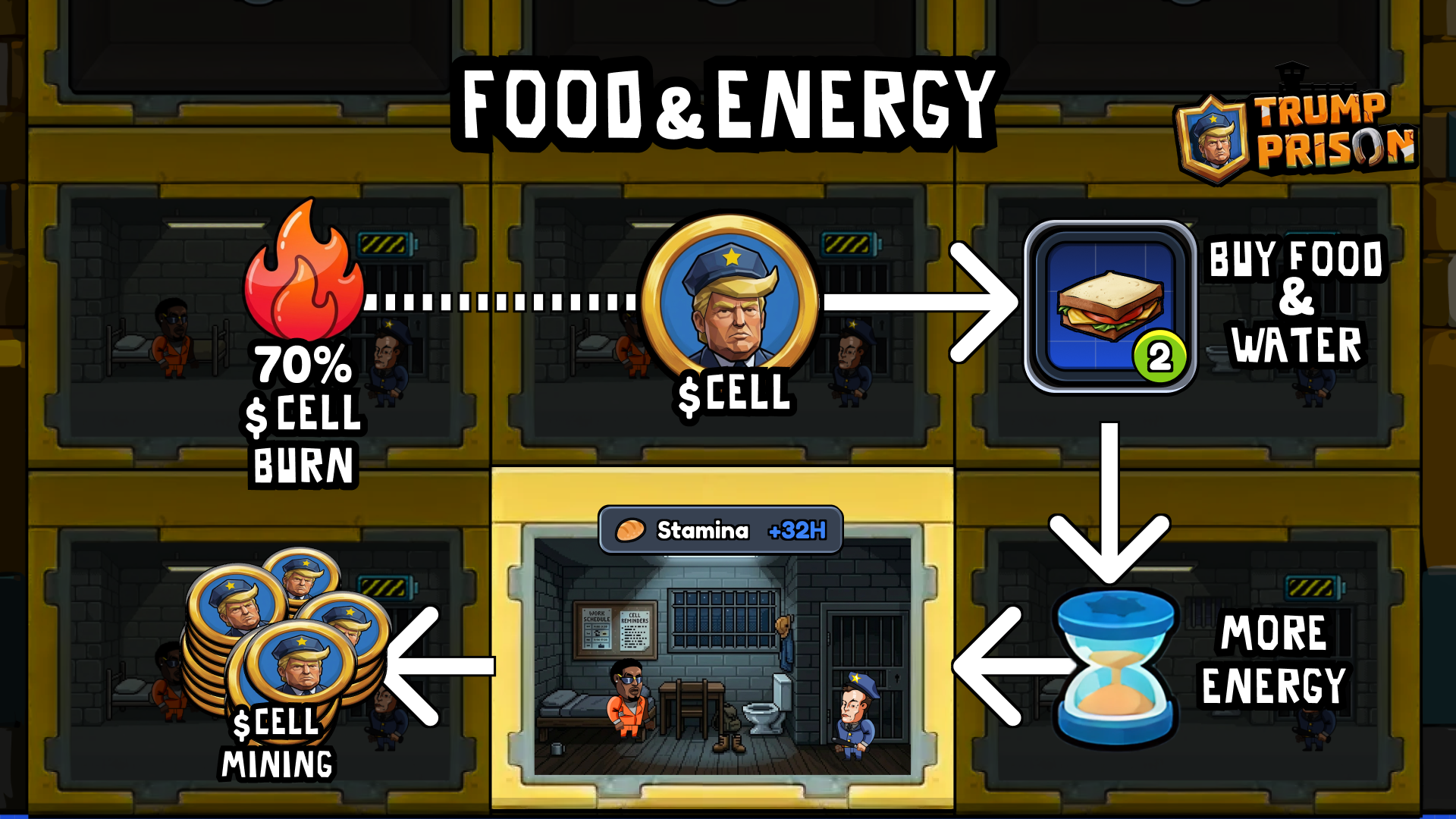
Energy supply controls runtime, and partial supply creates partial output.
Each Prisoner must be supplied with enough energy for a full 24-hour cycle each day. Energy comes from food and beverages bought with $CELL.
Energy rules
Energy does not regenerate automatically
Energy cannot be reset for free
Energy only exists for the number of hours supplied
Food and energy consumption
Food or Beverage
Calories Per Serving
Energy Duration (Hours)
Price ($CELL)
Fried egg (1 egg)
90
1.5
24
Oatmeal (40g dry + water)
150
3.0
54
Bread (1 slice)
80
1.5
21
Milk (250ml)
150
2.5
43
Coffee (black)
5
1.0
12
Sandwich (1 medium)
450
4.0
88
Soup (1 medium bowl)
250
2.5
48
Pasta (1 medium plate)
550
4.5
108
Meatloaf (1 slice ~150g)
400
5.0
125
Hamburger patty (1 piece ~120g)
300
4.0
92
Fish sticks (5–6 pieces)
300
3.0
60
Chili (1 medium bowl)
400
5.0
120
Vegetables (1 bowl)
50
1.0
13
Rice (1 bowl ~150g)
230
3.5
70
Bread (2 slices / 1 small roll)
200
2.5
45
Hot cocoa (250ml)
200
1.5
26
70% of the $CELL spent on purchasing food and beverages will be permanently burned.
One imported source repeated the Chili row once. That duplicate was merged here without changing the values.
Food and beverage spend is not just upkeep. It is also a recurring burn sink.
Partial energy logic
Trump Prison applies a real-time operation logic, not a simple “on/off” system.
If a Prisoner is supplied with only 12 hours of energy:
The Prisoner generates
$CELLfor 12 hoursThe remaining 12 hours are inactive
When energy reaches 0:
Prisoners stop generating
$CELLPrison Cells and Guards still exist but produce no output
Daily Prisoner activity
Each Prisoner must complete at least 1 hour of daily activity.
During this time:
Prison cell doors are opened
Prisoners take part in physical activities in the yard
Missing daily activity results in:
A 15% reduction in
$CELLproduction efficiencyIncreased risk of production interruptions
This system represents social stability within the prison and cannot be ignored.
Key takeaway
Meeting each daily requirement protects output. Partial supply creates partial output.
Last updated